Case Study: Possible Family Link to Gettysburg Turns into Discovery of Capture and Death at Andersonville
Tracing a Gettysburg Connection: Breaking Through a Civil War “Brick Wall”
Introduction
For years, the details surrounding my ancestor’s connection to the Civil War- and specifically how one relative ended up dying at Andersonville Prison-remained unclear.
While some records confirmed the outcome, they offered little insight into how those events unfolded.
That began to change after a question I hadn’t considered before.
The Initial Question
A while ago, I was volunteering at the Resource Room at the Gettysburg National Military Park’s Visitor’s Center when someone asked me something I hadn’t considered before:
“Do you have any ancestors that fought at Gettysburg?”
That question sparked my curiosity. I had helped many people track down their Battle of Gettysburg stories but had never investigated my own connections to this great battle that most consider the turning point of the war.
Starting the Search
The resource room is a great place to start. There are several databases available on computers that you can use for free, and usually a volunteer or two is there to assist you with your search.
Digitized options are readily available on ancestry.com, fold3.com, and others. Through these, you can locate service records, pension applications, and other documents that help track individuals.
Having access to these is extremely helpful—but sometimes there are missing pieces. That’s when the real search begins.
Identifying a Possible Connection
I found a soldier who could be from my family tree, or at least adjacent to it, and started to pull the string.
Many of us have known last names that we can begin with. When paired with a location, such as a hometown, we can start working backward to make stronger connections.
My soldier’s name was Charles Brought.
Census Evidence
Through Ancestry.com and Fold3.com, I found that Charles Brought was probably a nephew of my direct ancestor.
While examining census records from 1850 and 1860, I could see that he was only a few dwelling numbers away from my line of ancestors, with similar names and the same last name. Given that they came from this rural area of central Pennsylvania, it is very likely they were closely related.
The 1850 census shows Charles as a son of Daniel Brought. There were several men named Daniel Brought in this community—not uncommon, but worth noting.
Military Service and the Missing Gap
Records indicate that Charles Brought enlisted as a private in 1861 and re-enlisted in early 1864 with his regiment in Decherd, Tennessee.
I also found that he died at Andersonville Prisoner of War Camp on October 27, 1864.
However, based on the available digitized records, I couldn’t determine when or how he was captured and taken there.
The “Brick Wall”
I couldn’t close the gap between Charles’ re-enlistment in early 1864 and his death at Andersonville in October 1864.
Nothing available online provided the information I needed.
To move forward, I had to go to the National Archives in Washington, D.C.
Research at the National Archives
I scheduled an appointment through the National Archives website and took a day off work to investigate further.
After completing orientation videos, I traveled to D.C., obtained my researcher card, and began exploring.
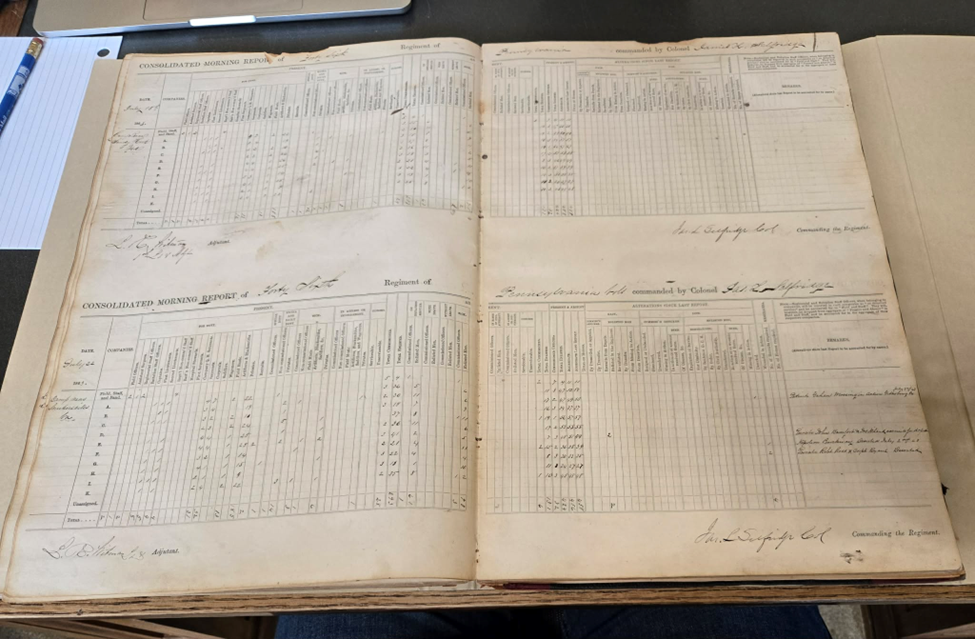
After reviewing microfilm materials, I spoke with archivists who helped me locate the finding aid for descriptive regimental books for the 46th Pennsylvania Infantry Regiment—Charles Brought’s unit.The 1850 census shows Charles as a son of Daniel Brought. There were a few men named Daniel Brought in this community, not uncommon but worth mentioning.
I requested all eight items related to the 46th Pennsylvania and filled out the necessary pull slip.
Then it was off to the reading room to wait for the records to arrive.
My only regret is that I didn’t spend more time using the scanners available. Instead, I took photos with my cell phone.
The Breakthrough
The “ah-ha” moment was well worth it.
As I flipped through the regimental descriptive books, I found the answer I had been searching for.
Charles Brought was captured near Marietta Crossroads on June 22, 1864. He died at Andersonville on October 27, 1864. To see it in the regimental descriptive book was the missing link I needed to connect the dots. I still would love to go back and dig through the books more.
Connecting to the Larger Event
A quick search indicates that he was likely captured during the Battle of Kolb’s Farm on June 22, 1864.
He was assigned to Ruger’s Brigade and would have likely fought near Kolb’s Farm.
Conclusion
I will definitely return to the Archives to get better images and continue the research.
The staff at the Archives were extremely helpful, and the experience was well worth the trip.
Call to Action
Are you facing a similar “brick wall” with your Civil War ancestor?
“Fisher Historical Consulting” specializes in navigating the National Archives to uncover these invaluable family stories.
Learn more about Civil War soldier research services here:
https://www.fisherhistorical.com